Wednesday, July 27, 2011

Chourico and Clams, Portuguese Style

Newark, NJ. Hardly a destination for most people. It's kind of a poster child for urban decay and the various ills that accompany it. But there is a part of Newark that I consider a worthy destination: the Ironbound neighborhood, Ferry Street in particular. This is the neighborhood where they shot the Sopranos episodes focused on Tony's childhood. The ethnic mix there is Italian, Brazilian and Portuguese. The Portuguese are very well represented, taking pride in the neighborhood and making it almost impossible to walk down the street without finding a taste of Portugal. Portugal tastes good.

I found myself on Ferry Street this week with a little time to kill. Had it been close to the dinner hour I would have stopped at one of the old school restaurants there. (Iberia Peninsula is a favorite). But it was early in the day, so I just stopped in a Seabra's grocery to pick up some Portuguese items I have trouble finding in Manhattan. Among them was a Chourico Serrano, which I used just under half of to make this dish. I love the combination of pork and shellfish, even though it may seem weird to some.

I served this with the sides you might find at a Ferry Street restaurant: rice, black beans and collard greens. This will feed two. A Portuguese vihno verde would be a perfect accompaniment.

Chourico and Clams
1 dozen Little Neck clams, scrubbed
1/3 lb Chourico Serrano, sliced
1 cooking onion, chopped
3 cloves garlic, chopped
4 Tbs olive oil
1/2 glass dry white wine
fistful of chopped Italian parsley

Heat a heavy bottomed pot, add oil and saute onions, garlic and chourico. Add wine and clams, bring to a simmer and cover. Clams will open in seven or eight minutes. Discard any that fail to open. Stir in parsley and serve immediately.

(This week I started a weekly food column in the Lo-Down, my neighborhood online news source. You can check it out here:

http://www.thelodownny.com/leslog/2011/07/jps-food-adventures-the-best-of-eldridge-street.html

Readers of this blog will find some familiar ground covered!)

Photos by Cynthia Lamb

Thursday, May 19, 2011

Blason Cabernet Franc, 2009

I just got back from a brief European tour with folksinger Rod MacDonald. A folk tour can be very different from a rock tour. It's still the same magic when you walk onstage, and the music can be just as transcendent. But you miss some things rock and roll gets you accustomed to, such as: monitors on the stage, a bus & driver, a tour manager, backstage dressing rooms, a crew and venues specifically designed for live music. Folk shows are smaller and more shoestring. The distance between performers and audience can be as little as three feet - more intimate than rock that way. You don't walk to the bus after a gig and ride through the night to the next one. After a folk show you hang out with the good people who came to see you, maybe even dining with some of them, tear down your minimal stage gear, sleep in a local guest house, then drive to the next gig in a rental car the following morning. Less glamorous, but you're rewarded with a strong sense of place and people. Places and people you might never see another way: Laupen, Switzerland; Obing, Germany; Vipiteno, Italy.

By far the biggest and loudest show of this tour was in Gradisca, Italy. Members of the local rock group Mr Tambourine Band sat in with us at a gymnasium. The stage was rock and roll loud. There actually were monitors, but they weren't much help. As a result none of us had any idea what this performance sounded like. I clearly remember letting a few notes during a solo ring out in hopes of hearing just where the downbeat was, as it became impossible to tell on my side of the stage. The bass player assured me things were no better on his side. But the crowd loved it, so I can only assume it sounded good where they were sitting, which is the most important thing. Afterward we had a lovely pasta dinner on tables set up in the back of the gym.

Gradisca is a beautiful little town, as far as I can tell populated entirely by lovely people. As this was my third time there I've actually managed to get to know some of them a little bit. One guy, an actor in local theater, is a fan of the music, and really seemed to dig my guitar playing. He remembered that I like wine, and graciously gifted me a taste of the local vineyard: three bottles from the Friuli producer Blason, located right in Gradisca.

The Blason Cabernet Franc 2009 was a standout among them. It's available here in the US (at least in California) for under $15 a bottle. Usually I find Cabernet Franc a little difficult on its own. Wine made solely from this grape often seems to be missing something to me - it rarely seems balanced. This one is. Nice fruit up front without being excessive or jammy. It ends a little quickly, but with clean tannins, inviting another sip. The wine is just big enough in the mouth to cover its 13% alcohol and still feel medium bodied. Along the way you get spice and black pepper following bright red fruits. Not a wine to show off with, but surprisingly good given its price tag. No one in their right mind would balk at this wine. The only criticism I can come up with is that this wine is a little simple, and the finish is a little short. It's a pleasure and a wonderful taste of Gradisca. If you're lucky enough to find this wine in your local shop I'd recommend picking up a bottle. It's one heck of a value. Made a wonderful gift, too!

Sunday, April 10, 2011

$30 Plate of Spaghetti? No Thanks!

My friend Coco kindly loaned me her copy of Anthony Bourdain's book Medium Raw many months ago. Shamefully I have yet to return it. Part of the reason is because I find myself often rereading part three, titled The Rich Eat Differently Than You And Me. He describes what he calls the Cipriani Model: the idea that the rich will pay outrageous sums to eat marginal food as long as they can be secure in the knowledge that others in their set will choose to do so at the same place. Places he describes with the words, "...restaurants that any food nerd with a Web site and a few bucks would walk sneeringly by."

I'll have to take M. Bourdain's word for that, as I have no plans whatsoever to hit the Rainbow Room or Cipriani. But as a food nerd I've noticed a trickle down of sort of thing. The most expensive meals I've had were rarely among the best, and when I think about my favorite places to eat, very few of them even qualify as moderately priced restaurants. That's not to belittle the work of the great chefs out there and the justifiably popular restaurants they operate. I just fail to see a strong correlation between the amount on the check and the deliciousness of the food when dining out, though I feel like I should. And I take issue with that.

I have nothing but my own experience to go on here, which tells me in most situations one hits a wall somewhere around $40 per person for dinner. I'm pretty convinced that after that point added expense has little to do with the quality of what arrives on your plate. (Sushi excluded, of course). After that you're paying for a place's prestige, its location and the privilege of dining among others who have no qualms shelling out that kind of money. That last one is key. You're not just paying for food costs, staff, rent and whatever other set costs one would assume contribute to the total sum. Tacitly or overtly you're paying to associate with members of a specific class, whether it's the one you happen to be a member of, or aspire to be.

There's nothing wrong with that, in my opinion. People have every right to eat at a place that's within their comfort zone, or even their aspiration zone. A nice place with a specific clientele, decor, service, wine list, etc... Maybe they even brag about how they source some of their ingredients. But will the food be "better" than at a place with lesser standards? Maybe yes, maybe no. Because the food only has to meet the expectations of the target audience. That's why the $30 plate of good (but not amazing) spaghetti exists in New York City. It all depends on your comfort zone.

But you know what? That ain't for me. I've tried for years to appreciate things like decor and service, and I've made peace with the fact that beyond a certain point I simply don't. I do not care how cute a place is, and as long as the service isn't completely feckless or rude I'm fine. The social status of the other diners in the room? I hope to be too engrossed in my meal and conversation to notice.

Which brings me back to the food itself: if the bill approaches $40 per person (or sails right past that) it had better be excellent. Because I know where to get excellent food for under $10 a plate in this town; fail to impress and I'm done with you. Helps to have a pretty broad comfort zone, admittedly.

Friday, April 1, 2011

Massaya: A Tasty Rosé for Spring

There may be a mix of rain and snow outside my window right now, but it's spring, which means soon it will be rosé season. Now is a good time to drink rosés in America. Back in the 60's pink wine meant Boone's Farm Strawberry Hill. In the 70's it meant Mateus or Lancers. Things got worse in the 80's. As if hair metal, trickle down economics and androgyny weren't enough we also got cloyingly sweet white zinfandel, which still accounts for 10% of the wine sold in the United States. (WTF?!) Fortunately things have gotten a little better in the 21st Century. Dry rosés have increased in popularity as the stigma against pink wine slowly recedes. This is a good thing, but it's driven up the prices of good examples from Provence (which is where many of the best are made). If you doubt this just ask one of your posh friends what they're paying for a case of Domaines Ott this summer.

So what are the rest of us to do on a hot afternoon when nothing would be better than a cold glass of pink wine? I found a number of good choices at a recent rosé tasting hosted by New York distributors Winebow. Aside from a couple stunning sparklers, the star of that tasting was Massaya Rosé, from Lebanon. That's right: Lebanon. You'd never guess. The bottle looks like one from Provence. On the nose and in the mouth you'd swear it was from Provence. It's crisp, refreshingly acidic without being overbearing, dry and even lingers a bit. It does make sense: the Lebanese climate is hot and dry, and they did learn wine making from the French. (Unsurprisingly there are a couple French heavy hitters involved with Massaya). The story is pretty good, too. The winery is located in the Bekaa valley, so Israel shelling nearby targets or blowing up the road to the vineyard can have an effect on some vintages. We're not just talking good wine, we're talking triumph in the face of real adversity. I'll support that.

Best of all, Massaya Rosé will retail for about $12 a bot when the 2010 vintage hits the shelves in a couple weeks. So let everyone in the Hamptons tear through all the $40 bottles of D.O. they want to this summer. I know what I'll be drinking, and it won't be from Provence. Lebanon's got my attention this year.

Sunday, March 27, 2011

Fish Curry!

I've never met a fish curry I didn't like. This one is both delicious and easy to make. It takes about half an hour. I used cod and squid last night, but you could use either. It would work well with shrimp, too. While fiercely tasty, I'll admit this curry is a bit on the mild side. You can adjust how tangy and hot it is by how heavy you go with the vinegar and hot pepper. When you open your can of coconut milk you'll be able to judge how thick it is; if it's half solid the curry will be very rich, whereas thinner will make a less rich curry. Both are good. If you have thick coconut milk you can always thin it down with a little water, but with thin you're best to use the whole can. One last point: most of my recipes are on the less salty side, because one can always adjust salt to taste at the table. You may want to taste and reason before serving. Beyond that there isn't much to this practically foolproof fish curry beyond making up some rice, dal and greens to go with it. If you really want to get crazy you could add a peeled boiled egg or two like the Malaysians do, but I think that would be gilding the lily in this case.

This recipe will serve four with rice, dal and greens.

1 1/2lb fish (I use 1 lb cod, 1/2lb squid), cut into bite sized pieces
2 Tbs white vinegar
3-5 cloves garlic, chopped
1/2 inch piece of ginger, peeled and chopped
1tsp black mustard seeds
2Tbs oil
1Tbs each: coriander, fennel and cumin seeds
generous 1/2 tsp turmeric powder
1/4 tsp Indian hot pepper powder (or cayenne)
jalapeno pepper, sliced in rounds (seeds and all; don't be a wuss)
2-4 tomatoes, cut into generous chunks
14 oz can coconut milk (if thick use 2/3 of can)
1/2 tsp salt
1/2 cup chopped cilantro, to garnish (or more, to taste)

In a bowl marinate seafood in vinegar. In a dry frying pan toast coriander, cumin and fennel seeds until fragrant. Let cool and grind together in a spice grinder (I like a cheap whirling blade coffee grinder). Toasting the spices is the secret to the curry - it's easy, so don't blow it off! In a large pan heat oil and black mustard seeds. When you hear the first seed pop add jalapeno pepper, ginger and garlic. Let fry for about a minute, then add tomatoes and salt. When tomatoes have softened a bit add coconut milk, turmeric, hot pepper powder and the toasted spice blend. Take a whiff of what's happening - it should be glorious! When tomatoes are cooked add seafood with the juice at the bottom of the bowl. The seafood will cook in 2-3 minutes. Garnish with cilantro and serve immediately.

Monday, March 21, 2011

Eldridge Street, Chinatown, Manhattan

Generations of New Yorkers have enjoyed the luxury of good, inexpensive Chinese food, some of it Americanized, some less so. Today Chinatown has more choices than ever: Old guard Cantonese, complete with roast ducks hanging in the windows, trendy Shanghai joints serving soup dumplings, dim sum restaurants, bakeries, tiny counters where people start the day with a cup of tea, a bowl of congee and a doughnut... Most New Yorkers have their favorites, whether it's Wo Hop, Hsin Wong, Joe's Shanghai, Mei Li Wah Coffeehouse, NY Noodletown or lesser known places they'd rather keep to themselves. Manhattan's Chinatown might not be as vibrant as Flushing's, but it's no tourist theme park, either. Granted, a few blocks have become that, but Chinatown stays refreshed by waves of new immigrants arriving and setting up shop. Many of the shops they set up happen to be food related businesses.

As a home cook I admire the frugality of Chinese cooking in general. Wastefulness is frowned upon, and value is appreciated; that lines up with my own way of thinking very nicely. I don't go out to eat often, but when I do it's no surprise when I end up in Chinatown. There are so many places where the food is good and I leave feeling like I got my money's worth (and then some). Extreme examples of this seem to be clustered on, or very close to Eldridge Street. They stand out so sharply in my mind that I drag people there. But they never seem to mind.

It's fun to eat delicious handmade food in places where if lunch costs more than $8 you're doing it wrong. A buddy from San Fransisco proclaims the dumplings in these shops "the best potstickers I've ever had." My dear friend Richard Priest calls them "pork porn." It was fun to watch band mates Jeff Kite and Mike Bloom overcome by the first bite of the Lamb burger at X'ian Famous. Or Julian Casablancas suspiciously eye a Fujian fish ball before trying and liking it. It was fun to see if my brother could polish off an order of dumplings and a bowl of hand pulled noodles. (He can). It's fun to see out of town guests shocked that places like these actually exist in 2011 New York. (There's so much more to this city than $14 cocktails and $35 plates of pasta!) It's even fun to pick up the tab; the damage is very little here.

So I'm going to take a break from offering home cooking ideas and instead suggest a walk down Eldridge Street. Depending on where you live and what your plans are for a New York City visit this may or may not be a practical suggestion. It stands as a tasty, inexpensive suggestion, regardless. Here's where I go:

Vanessa's Dumpling House, 118 Eldridge St. This is a good place to start. Word is out, and it's often crowded. What to get: fried pork and chive dumplings (four for a buck), sesame pancake sandwiches, homemade pickled cabbage (like a milder, sweeter take on kimchi). Mr Dunn, Glaswegian guitar tech extraordinaire (and a man with no patience for anything frou frou) considers this place a "top call." I took my nieces here years ago and they still talk about it. You can get more tasty food than most can consume in one sitting here for $4, all of it made before your eyes.

Prosperity Dumpling, 46 Eldridge St. There's a running debate on who has the better fried pork dumplings, Prosperity or Vanessa's. To me it's a knife-edge call: if you like more of a ginger flavor you'll prefer Vanessa's, but if thinner wrappers and pronounced scallion flavor are your thing Prosperity wins. A few years ago Julian Casablancas and I did a Lower East Side fried dumpling shootout, and Prosperity was our winner. The place can seat maybe ten people, so get your dumplings (five for a dollar) to go. Eat them walking down the street; they won't last half a block. Word is out about this place, too, so there is sometimes a line.

Super Taste, 26 Eldridge St. You can get good dumplings here, too, but the hand pulled noodles in soup are the star of the show. The spicy beef version is noteworthy, and quite spicy the last time I had it. (Also a bargain at about five bucks). You can watch the guy making noodles behind the counter.

Sheng Wang, 27 Eldridge St. To me this place is the star of Eldridge Street, and word seems to be getting around. Though the crowd is still mostly Fujian I've noticed other "aging hipsters" on recent visits. English is spoken here, but haltingly. Best to just point at the menu. Their policy has been not to serve tea, but they've realized many Westerners expect it, so it seems to show up at tables where Westerners are sitting. Last time I visited it arrived in small styrofoam soup containers. Very charming, even though the tea itself is weak. They offer both knife peeled and hand pulled noodles; the former are more interesting, but the latter are a little better, among the best I've had. Their steamed dumplings ($3 for 12) might be the best on Eldridge street - thin skins and a perfect balance of ginger and scallion flavor. They've elevated the lowly fish ball into a work of art as well, by giving it a ground pork center. It's obvious they're proud of that because they sneak one into most orders of soup, regardless of what you have ordered. I cut to the chase and order the hand pulled noodles in soup with fish balls ($4.50) to assure I get five or six in my bowl. Fifty cents extra gets you a fried egg on top.

Xi'an Famous Foods, 88 East Broadway. Walk to the southern end of Eldridge Street and you're looking at the base of the Manhattan Bridge. One of the businesses there is Xi'an Famous. This is food from Western China, with a Uighur influence. Nearly everything is oily, salty and spicy (cumin and hot pepper are well-represented). Imagine a mix of Chinese and Middle-Eastern flavors and you're not too far off the mark. Lamb and pork are the meats available, and their handmade noodles are completely different than those of their Eldridge Street neighbors - starkly white and quite thick. Most of the dishes here are too much of a commitment to eat on the street, and the shop's tiny counter can only accommodate three diners. So only go for the Cumin Scented Lamb Noodles, the Liang Pi Noodles or the Spicy and Tingly Lamb Face Salad (all excellent choices) if you're of a mind to seek out a bench somewhere to sit down and eat them. (You are just a block from Sara D. Roosevelt Park). If just a quick grab and go is more your style I'd have to recommend the lamb burger ($3.50): cumin scented lamb served on a bun that is like a tough Chinese version of an English muffin. That might not sound appealing, but trust me: it is sublime.

Monday, March 7, 2011

Bitter Melon


I like food with character. I don't need bold, assertive flavors 24/7, but I'll admit I gravitate to them. Bitter melon is a favorite of mine. It isn't for everyone - while popular in Asia, it's more of a cult veggie among Westerners. It's name is only half correct: it's not a melon; it's a gourd. But it is bitter, possessed of the powerful astringency of quinine. Some say the flavor reminds them of asprin. It has a medicinal taste, and in China has many uses in traditional medicine. I've heard of it being good for diabetes, hangovers and psoriasis, among other things. It is densely packed with nutrients, to be sure. But most important to me is that its astringency is a perfect foil to one of my favorite foods: pork.

On Chinese menus it appears in soup or stir fried with beef, but I'm of the belief that bitter melon is at its best with pork in a black bean sauce. And not sliced pork, char siu or the more traditional little spare rib chunks, either. I like it with coarsely ground pork. This has been in pretty regular rotation in my kitchen for 20 years. I'll include it on the menu for dinner parties sometimes, and am still surprised when it's one of the first dishes to be polished off. Bitter melon's flavor can be a bit much for some, but against ground pork and black bean sauce it's capable of winning people over. I'm capable of eating almost half a pound of bitter melon in a sitting, and am lucky enough to be married to a woman who takes great joy in doing the same.

Bitter melon can be found in Asian markets. You want it green, not orange. Sometimes you can find the Thai variety, which is white and very mild. The Indian variety is darker and even bumpier, not what I'd use for this dish. Right now bitter melon appears to be out of season in the Northeast, so not everyone has it, and it's $4 a pound - more than twice what I pay in the summer. But I'll pay it, because I need my fix. Today was one of those days, hence this post.

Approach the bitter melon by slicing it down the center lengthwise (unlike my picture above). Use a teaspoon to scoop out the seeds and white pulp, which you discard. Cut each half of the vegetable into 1/4" half rounds, and you're ready to go.

Note: Bitter melon is not a fast enough cooking vegetable to stir fry the way you would a bell pepper. You have two options for getting it cooked through: you can boil the slices for a few minutes beforehand, drain them and let dry before stir frying. Or you can let the finished dish simmer in the wok over low heat, covered, for a few extra minutes to finish cooking the bitter melon. I like the second method, although it seems to violate standard wok practices. Just remember the less cooked the melon the more bitter it will be. You don't want it totally soft, but you do want it cooked through.

The recipe below will makes enough for a complete dinner for two over rice, or will feed as many as six as part of a larger meal. (The black bean sauce in the recipe is also a no-brainer for seafood dishes, and even works for chicken and vegetables).

Pork and Bitter Melon in Black Bean Sauce

3/4lb bitter melon, cut in half-rounds as described above
1/3-1/2 lb ground pork (coarse is better)
2Tbs Chinese fermented black beans soaked in 2Tbs Chinese rice wine
Tbs soy sauce
1/2tsp sugar
1/3 cup chicken stock
3-4 cloves garlic, chopped
1/2" piece ginger, peeled and chopped
1 jalapeno pepper, sliced into rounds
3Tbs peanut oil, for frying
heaping Tbs cornstarch made into a slurry with and equal amount cold water, to thicken

Pour oil into hot wok. Add bitter melon and stir fry for 3-4 min, adding a little oil if needed to keep from sticking. Add garlic, ginger and hot pepper and fry another minute. Add ground pork and sugar and fry until pork is mostly cooked, about two minutes. Add chicken stock, sugar, black beans in rice wine and soy sauce. Lower heat and let simmer (covered works fine) until bitter melon is cooked through, about four minutes. Stir in the cornstarch slurry until the liquid is the consistency of gravy. Discard extra slurry. Serve over white rice.

Saturday, March 5, 2011

Pork Vindaloo


A pork curry? That doesn't square with Muslim curry eaters (and most Hindus), but there are Christian communities where pork is eaten on the Indian sub-continent. This dish is from Goa, where Portuguese missionaries arrived many generations ago. I've heard speculation that the vinegar in the dish was inspired by Portuguese stews cooked in wine. Makes sense - a pork curry would almost have to be a fusion dish, wouldn't it? The tangy vinegar nicely plays off the spices and the richness (read: fat) of the pork. It's very good.

Spicy pork served with rice hits my happy button pretty hard, and as a result I have two ways of preparing this dish. There's a quick method using pork loin (since loin gets tough when overcooked) and a long simmering version using shoulder meat. The long simmering method is a little better, but my source for pork (Hoosic River Poultry at the Tompkins Square Greenmarket) is often sold out of shoulder by the time I get there, so I learned how to make due with the more expensive and less tasty loin. Marinating the meat in the curry paste and adding some tomatoes (two tricks I picked up from a recipe by Emeril Legasse) make the quick method work. When slowly cooking the shoulder meat I leave out the tomatoes in favor of a cinnamon stick and a few cardamom pods. Either is a good excuse for a trip to the spice shop.

I serve it with white rice (basmati is good, but any rice works), dal and spinach. I've included my recipe for toor dal below, but you can use whatever dal recipe you like. I like toor dal because it's interesting; it looks like giant yellow split peas, but has a taste all its own. The spinach is easy to make: just saute a little chopped onion, garlic, ginger and hot pepper in oil with a pinch of salt, then add spinach until everything is cooked. Frozen spinach works fine.

Note: My curries sucked for a long time, because I was intimidated by the steps and ingredients involved, and tried cutting corners. I half-assed it, instead of just going for it. The bottom line is that this meal will take just over 40min to make using the quick method or about an hour using the slow cooking method. The dal takes about 40 min to cook anyway, so put the dal on first, get to toasting the spices, do the rice and spinach while the meat marinates/stews (depending on which method you use) and everything will come together at more or less the same time. You'll be busy enough that you won't have time to be intimidated! And you get an impressive pork curry when you're finished.

The recipes below feed two, with easily enough left over for lunch the next day:

Pork Vindaloo

For the curry paste:

Tbs coriander seeds
Tbs cumin seeds
Tbs black mustard seeds
6-8 whole cloves
1/2 tsp salt
tsp turmeric
1/4-1/2 tsp Indian hot pepper powder (or cayenne)
1/3 cup white vinegar

Toast coriander, cumin, mustard and cloves in a dry frying pan, shaking every minute or two so they don't burn. When you can smell them turn off heat and let cool. Grind in spice grinder and mix in small bowl with remaining ingredients. Congrats, you've made a vindaloo paste from scratch!

Quick method:

1lb pork loin, cut into bite sized cubes
curry paste, above
2 onions, chopped
3-4 cloves garlic, chopped
Tbs chopped fresh ginger
3-4 canned whole tomatoes (depending on size), broken up by hand, with their juice
2-3 Tbs cooking oil
cilantro leaves, to garnish (optional)

Marinate pork in a bowl with curry paste for at least 20 min. In a heavy bottomed pot saute onions in oil until nearly translucent. Add garlic and ginger and saute another minute or two. Add pork to pot, leaving excess marinade in bowl. Cook for five minutes, until spices start to stick to bottom of pot. Add tomatoes and remaining marinade and simmer for five minutes more, until pork is cooked through. If you're skittish about the pork being fully cooked simmer a minute or two more, but remember if you overcook the loin meat it will be tough. Serve garnished with cilantro leaves (optional).

Slow cooking method:

1lb pork shoulder, cut into bite sized cubes
curry paste, above
2 onions, chopped
3-4 cloves garlic, chopped
Tbs fresh ginger, chopped
1 stick cinnamon
5-6 whole cardamom pods
1 heaping tsp brown sugar
2-3Tbs cooking oil
1/2 cup water

In a heavy bottomed pot saute onions in oil until nearly translucent. Add garlic and ginger and saute another minute or two. Add pork and saute until cooked on the outside. Add remaining ingredients, cover and simmer for half an hour. Remove cover and simmer another half hour, until pork is tender, stirring every now and then and adding a little extra water if needed to keep from sticking. Serve garnished with cilantro (optional).


Toor Dal:

!/2 cup toor dal (available at Indian grocery stores)
1 1/2 cups water
1/4 tsp salt
1/2 tsp turmeric
2-3 cloves garlic, chopped
1tsp ground cumin
2Tbs cooking oil
1 heaping tsp brown sugar
juice of 1 lemon or lime
cilantro leaves, to garnish (optional)

In a small pot bring dal, water, turmeric and salt to a gentle simmer. Simmer for about 40 min, stirring every now and then, so it doesn't stick, until dal is cooked. It should be like a thick soup. Add a little extra water if it gets any thicker than that. Turn off heat and mash with a fork or potato masher. In a pan fry garlic in oil for a minute or two. Add mashed dal and remaining ingredients, stir to mix together well and turn off heat. Garnish with cilantro (optional).

Friday, February 25, 2011

Pörkölt

I'm usually so busy eating pork and fish I sometimes overlook the wonder that is beef. I do keep a chuck roast in the freezer most of the time, and recently this has been how it often ends up. While many variations of paprika stew exist, Pörkölt is the most basic, not to mention incredibly tasty. No sour cream, potatoes, tomatoes or sauerkraut involved. Just onions melted in lard, meat, salt, paprika and a little water. (I add garlic and a sprinkling of caraway seeds, which is enough to raise eyebrows among purists). Because of this you want to make sure you use good paprika - the best sweet paprika you can get your hands on. I won't use the nasty lard from the supermarket, either. I get mine from Flying Pigs Farm, so it's outrageously expensive, but delicious, and a little goes a long way. Try to find a good source. This dish is traditionally low simmered until the meat is tender, but it works equally well in a pressure cooker. Serve with boiled or mashed potatoes, dumplings or egg noodles. (I favor garlic mashed, because I have yet to master proper dumplings). Add one of those Germanic salads from a few posts ago and you have a perfect winter meal. Simplicity is good.

This recipe will serve 2-3:

1 1/2 lb beef chuck, cubed
3 onions, chopped
3-4 cloves garlic, chopped
1 tsp lard
salt, to taste
2 heaping tsp sweet paprika
1/4 tsp caraway seeds
1 cup water

Heat lard in pot. Saute onions, garlic and salt over medium heat. Add beef and paprika when onions are nearly translucent and saute for a minute or two. When it starts to stick (don't let it burn) add water and caraway seeds. Cover and bring to a gentle simmer. Simmer until beef is tender, about one hour (or 15-20 min in a pressure cooker). Check several times to make sure liquid doesn't cook off; if needed add a little more water. (You don't need to do this if using pressure cooker, but your gravy will not be as thick as the long simmering method).

Monday, February 7, 2011

"Healthy Food" Rant

I've heard this one too many times: "I want to eat somewhere healthy." Usually spoken by someone looking for a quick bite out. I take it as a sign I will not be dining with that person. Not because I'm against so called healthy eating; changing my own diet allowed me to drop 45 pounds over the last four years. I just reject the notion that one food is healthier than another. Think about it: going to a place that touts healthfulness invariably leads to expensive food short on flavor, often with a dose of dogma to make up for it. It's "healthy" because it's (insert one or more of the following: raw, vegetarian, vegan, gluten-free, low fat, low carb, low salt, macrobiotic, organic or whatever the health trend of the month happens to be).

I understand the desire to grasp at food dogma; one wants to eat healthy, and many of us suspect we do not. But this quickly leads to a forest for the trees scenario. Is the organic vegetarian convenience food item from, say, Trader Joe's obviously a better bet than a bean burrito from Taco Bell? Is the (god forbid) grilled chicken Caesar salad a healthier choice than a burger? Is it really a good idea to punish your taste buds and wallet with the organic quinoa salad and marinated seitan after going through the trouble required to find a place that offers such items? Maybe, but I hardly see any cut and dry answers in this regard. Yet people who make such choices will defend them because they're convinced they are eating healthy by doing so. And I have no reason to suspect they're right in this regard. I refuse to accept that the "healthy choice" is the boneless, skinless chicken breast or the vegetarian option. I don't believe fast or convenience food undergoes a transubstantiation to health food through the power of faith in the grilled chicken breast.

Some absolutes exist. If you cook from scratch at home, not going crazy with the salt, fat and white carbs you're doing better than most dining out options, if healthfulness is your goal. Given. If you eat meat it seems reasonable to be concerned with its provenance, given how much livestock is raised in our industrialized world. And you're probably doing yourself a favor if you manage the complicated trick of avoiding most products of the modern food science lab. At least there's reason to suspect as much. I'll admit to casting a wary eye toward most ready to eat items in supermarkets and convenience stores - things that can sit there for inordinate lengths without going "bad". The longer and less pronounceable the list of ingredients the less likely I am to eat it. But beyond that I don't think there are many absolutes when it comes to specific food items.

I don't think fried chicken, bacon, foie gras or triple creme brie are unhealthy. Nor is a cheeseburger and fries. Or a pizza. Spinach, carrots and hummos are not inherently healthy - eat enough of any and they will poison you. (Eight to ten pounds of spinach is enough to kill you). As convenient as it is for marketing, classifying particular foods as healthy is misguided. It's anti-cuisine, anti-pleasure and unfounded. Fat isn't bad, carbs aren't bad, and I refuse to be convinced that salt and sugar are bad. PATTERNS of eating are healthy or unhealthy, not foods themselves. Recently I've seen the trinity of corn, wheat and soy portrayed as unhealthy, which is nonsense. Pasta, corn tortillas and soy sauce are not out to get you. But a pattern of eating prepared foods made largely from processed corn, wheat and soy? Might not be a good pattern. We know that. If you have any doubts just head to the supermarket and look at the people pushing carts brimming with packaged heat and eat (or ready to eat) items. Do you want to look like that? Then don't eat like that. But even these foods fail to be evil incarnate (although they're probably close). If you like a TV dinner it's not unhealthy to have one. But every night? Welcome to Fatsickville. Potato chips or ice cream? Why not, once in a while? But every day? WTF? It's not the food; it's the pattern of eating. If you eat mostly vegetables rounded out with a little fat, some meat or fish and some carbs you're probably doing fine, regardless of whether or not you eat a pizza or a double cheeseburger once in a while. "Once in a while" being the key phrase.

Your home is where you have control over what you eat. Cook real food. Eat reasonably. It doesn't require lots of time or money, though they do make it easier. Probably best to avoid a pattern of grabbing food on the run. We know that's not a good pattern, even if you choose the so-called healthy options. They're usually not that healthy. And they're expensive. They'll leave you hungry later, more likely to start snacking. And they often taste like crap. Even when they don't it's a gigantic leap of faith to believe a $7 glass of juice with some protein powder or a $10 grilled chicken salad is a healthier lunch than last night's home cooked leftovers. I think of it like this: if I eat defensively most of the time I never have to fool myself into considering "healthy options" when dining out.

Wednesday, January 12, 2011

The Best Thing We've Cooked in a While

It started off with my wife announcing that she was going to make a batch of homemade pasta. I said I'd be happy to make the sauce, and she indicated a preference for a seafood sauce. I figured I'd go in a Sicilian direction, but didn't want to get too close to puttanesca territory. A quick trip to my favorite Chinatown fish market yielded a dozen little neck clams ($4), a pound of cleaned squid ($4) and a pound of shrimp ($5). I had anchovy paste and capers on hand, but knew these would have to be used in a restrained manner. But I had a trick up my sleeve: the shrimp heads and shells boiled in half a glass of white wine gave me a strong shrimp liquor that I added to the sauce. This, along with the juice the clams gave off while being cooked in the sauce added a depth far beyond what the anchovy paste alone ever could have.

The boys got wind of what we were up to and promptly invited themselves to supper, making it a family dinner for four. While it was not a complicated meal, nor an expensive one it did require about an hour of work from two people to make. Then again, we're not the fastest cooks in the world, and it had been over a decade since my wife had made fresh pasta. We could probably bang it out again in 45 min. And we probably will soon. This was much better than what I've had in good mid-tier Italian restaurants here in NYC. And the food cost to feed four was under $15. The worst part of the experience was cleaning the shrimp, but having the shells and heads to beef up the sauce was more than worth it. The extra buck-fifty for the already cleaned squid money well spent, however. This was hardcore enough.

My wife went with a half white, half semolina egg pasta. Rolling it out to the #5 setting on the Kitchen Aid mixer's pasta roller attachment made noodles that cooked to surprising lightness in about two minutes. Hand cutting gave them a pleasant unevenness that highlighted the fact that it was homemade. The noodles were about twice the width of fettuccine making them perfect against the sauce, which came out a bit richer than I'd anticipated (thanks to the shrimp shells).

The payoff for the effort involved was the best meal to come out of our kitchen in a while. And, without bragging, I can say good things come out of our kitchen on a regular basis. This will serve four as a main course or six as part of a larger meal.

For the pasta:

3/4 cup semolina flour
3/4 cup unbleached white flour
2 eggs
2 Tsp water
2 Tsp olive oil

Mix ingredients together and knead for 10 minutes (a mixer with a dough hook makes this easier). Ball it up and place in oiled bowl. Cover and let sit for 20 minutes. On a lightly floured surface cut into four pieces. Feed each piece individually (again, easier if you have the attachment for your mixer) as follows: Roll five times on #1 setting (it may rip, that's OK), once on setting #3 (if it rips here start rolling all over again) and once on setting #5. By now it should be a giant flat lasagna noodle. Gently lay on floured surface and cut into noodles about 1/4" wide. Drape noodles over drying rack or the edge of a very large bowl. Repeat until all four pieces of dough are noodles.

When you're ready to go with a large pot of boiling salted water cook pasta. It will cook in about two minutes, so make sure sauce is ready to go before cooking pasta.

For the sauce:

3-4 Tbs olive oil
5 cloves garlic, chopped
1 Tbs anchovy paste
28 oz can tomatoes (crushed or whole, broken up by hand with liquid)
1 Tbs capers
1/2 tsp crushed red pepper
1 doz clams (I used little necks, smaller is better), scrubbed
3/4lb whole shrimp
3/4lb cleaned squid
1/2 glass white wine
black pepper, to taste

Clean the shrimp, placing shells and heads into a small pan with the wine. Bring to a simmer. Cut the squid into rings and tentacles, and set aside with shrimp meat. In a large pan heat olive oil, garlic and anchovy paste. Fry for about 30 seconds, then add tomatoes, capers and crushed red pepper. Bring to a simmer. When shrimp shells have turned bright pink remove from heat, and carefully pour liquid into the simmering sauce. The liquid ought to be a robust orange-pink. Place the clams into the sauce and cover. When they open they're cooked. Remove cooked clams from sauce, making sure their juice remains in the sauce, and set aside. Discard any that fail to open within ten minutes. At this point the pasta should be ready to go, because you're about five minutes from plating it. Add shrimp and squid to the simmering sauce. When the shrimp turn pink it's done. Cut the heat and add the cooked, drained pasta, stirring to sauce evenly. Plate the pasta, placing the clams attractively on the side of each plate, or if the clams are very small you could toss them with the pasta before plating. Serve immediately.
Photos by Cynthia Lamb

Tuesday, December 21, 2010

2010 Food Trends I'm Sick of

I'm thinking about somewhat expensive meals I've had out in trendy restaurants in 2010. I don't eat like that often, since I cook and tend to favor more traditional foods. But as much as I love grandma cooking I can't bury my head in the sand. There's a big culinary world outside my door, and I won't pretend it doesn't exist. Unfortunately I'm seeing quite a bit bandwagon hopping, brought on by the economic downturn. Something works for one place and it's immediately copied ad nauseum. I'm all for innovation from the very few who can be innovators; I can do without watered-down copycats. But they seem to be everywhere in one form or another. Here are some of their crimes I've noticed this year:

Asian fusion - When it happens organically we get brilliant things, like Vietnamese sandwiches, Japanese curries, Thai food, Korean tacos and Sriracha sauce. In the hands of inspired and talented chefs we get some of the top restaurants in the country, offering exciting flavors and signature dishes. But as a concept in less expert hands it leads to gimmicky, overpriced food. A recent example I suffered through was Asian fusion Southern BBQ soul food. Japanese pizza makes more sense to me, and that's not saying much.

"Gourmet" junk food - A good burger is a good thing, so don't make it a con job. Anyone who sources their meat well and treats it with respect can turn out a good burger. When restaurants start duping the gullible by throwing supposed Kobe beef into a meat grinder and charging high dollars for the destroyed result I'm going to take offense. Same goes for posh places offering "sliders" as appetizers. It's not cute; it's infantile. Don't mess with pizza, either. I have no problem paying over $20 for a pie with a perfect crust and top shelf ingredients lovingly fired in a wood burning oven. But charging that much for a so-so pizza just because someone decided to express themselves by piling it high with silly toppings? That's not only insulting your customers, you're insulting the very concept of pizza. Honest junk food made from good ingredients is a delicious indulgence. Tarting it up and trying to pass it off as fine food is a con job.

Pork belly - I love pork in all of its wonderful forms, belly included. I'm happy it made something of a comeback, and I'll indulge a few times a year. But I don't need to see it on every menu. It's getting a little tiresome.

Ridiculous portion sizes - If I want tapas, meze or dim sum I'll go to places that specialize in such. But if you're going to charge me $12 for three mini-tacos because your concept is "Mexican tapas" I'm going to call you a rip-off artist. Reasonable portions, please. This cuts both ways: if I order an appetizer and a main, and am too stuffed to do more than pick at the main there's a portion control issue, unless it's obvious that dishes were meant to be shared. Unless I'm there for a tasting menu I don't expect to waddle out of a restaurant in pain. And if I have to order four or five items to make a meal I expect there to be at least a vague correlation between the prices and the quality of what arrives at the table. Calling it "tapas" is not an excuse, unless what you serve is actually tapas.

Over salting - I'm not anti-anything, with the exception of low end commercially processed food. Fat is fine. Carbs are fine. Sugar is fine. Salt is fine, too. I expect restaurant food to be saltier than home cooking. When I go out for ramen I know I will consume twice the recommended daily salt intake in half an hour. But I don't expect to be unsure whether the burn in my mouth is from chili peppers or salt, which has happened in more than one popular NYC restaurant. I don't expect to go to a place famous for meticulously sourced ingredients prepared simply, only to find more than one dish nearly inedible because an unsure hand in the kitchen got too enthusiastic with the salt. Salt brings flavor to life, and an extra pinch improves simply prepared food. There is a point of diminishing return, though, and acknowledgment of it would be nice. I know making the food a little extra salty boosts wine sales, and I expect that from a wine bar. I prefer a little more restraint from a restaurant.

Cocktails with food - The fancy cocktail trend is well past its peak. I haven't heard the word "mixologist" in over a year, and I'm thankful for that. So I must voice my disapproval of those who try to prop up this waning fad by suggesting food/cocktail pairings. I'm sure that's great for people who don't like to taste their food, but for the rest of us the idea is laughable.

The "locavore movement" - Now that organic is nearly meaningless people need something to hold onto. So let's take a few things that make sense, such as eating seasonally and favoring locally produced foods, then build some misguided ethos out of it. No thanks. I have no plans to do without my coffee, wine, olive oil, citrus and spices, and have no desire to be part of any "movement". See you at the farmer's market.

Abuse of truffle oil - Oil is the poor man's way to get some truffle flavor into a dish. Yes, it can make your mashed potatoes ethereal, and turn a simple plate of grilled asparagus into a fine starter course. When did it become a commonplace thing, and should we be happy about it? I've only had real truffles a few times in my life, but the oil seems to be everywhere. I don't approve. It's kind of like passing off lumpfish roe as caviar, eating it often, then becoming jaded to the wonder of the real stuff. Or drinking so much prosecco in cans (yes, they sell it in cans) that you lose the ability to appreciate champagne. Hopefully the recent steep decline in truffle oil quality will return truffle flavor to the rare pleasure it once was. As tasty as they may be, a side of truffle fries sitting next to your $25 dollar hamburger is silliness. So is a $10 egg on toast flavored with the stuff. Enough already.

Wildly overpriced Mexican in NYC - I know that good inexpensive Mexican food in this town usually requires a trip to unfashionable neighborhoods. And I appreciate the handful of places that serve truly high end Mexican food. What I can't stand is places that are little more than mediocre taquerias, priced as if they were fine dining establishments because of their location in trendy neighborhoods and the fact that they pour top shelf tequila. I can practically hear the laughter from the left coast, and I'm ashamed for my fellow New Yorkers. This has got to stop.

My fear for 2011 - Sugar. In everything. Sweet sauces everywhere. Meat never served without a sweet wine reduction, a fruity sauce or some kind of sugary Asian fusion rub/dipping sauce. Wine lists will run in the opposite direction, moving toward flinty, mineral wines without a hint of residual sugar, making the sweet food completely unable to pair with anything on the list. And everyone who just graduated from waiting in line for Shake Shack will think it's wonderful.

Sunday, December 19, 2010

Worth a Read: Luard's European Peasant Cookery

My buddy Richard Priest happens to be something of a polymath, in addition to being one of the best tour managers in the business (also business manager, aspiring producer and most recently, a welder). This man endures my endless talk of food with the patience of a saint, setting aside chunks of his precious downtime to join me for walks around Chinatown, where we seek out holes in the wall serving delicious meals for pocket change. His fluency in Mandarin gives him a better picture than I'll ever have of the goings on around us. (I have only a handful of sentences in Cantonese). Every now and then he honors me by being a guest at my table.

One such night Richard gifted my wife and me a copy of Elisabeth Luard's excellent book: European Peasant Cookery. This book is not breaking news. It was published in 1986. The recipes are for foods that are hundreds to thousands of years old, covering cuisine from Norway to Turkey. It's more than a collection of recipes - it is a great read. Luard can write, and chooses to preface most recipes with engaging descriptions of the land and the people, putting the recipes in cultural context. No surprise this woman has had over ten books published! This one is both inspiring for the cook and, I would guess, a pleasure for anyone interested in reading about food.

European Peasant Cookery provides the reader with a vibrant mental map of traditional cuisines across Europe. For me this not only brings back memories of meals I've had while traveling, but it adds new must tries to the list for future travels. Traditional food pairings are sketched out as well, which is great for those who appreciate thematic continuity at the table.

Then there are the recipes themselves: all bulletproof. Luard puts them in context, mentioning a few variations and common substitutions. By the time I set out to cook I don't even need to refer back to them; they seem as obvious as if I'd learned them from my grandmother. Sure, some of them are beyond the scope of what I plan on doing in my NYC apartment. As of yet I have no plan to cure my own ham or bacon, for example. Nor will I be making my own skyr (Icelandic farmer's cheese), though I wouldn't put that past my wife, who already makes her own buttermilk. Let's face it, cooking at home is much more enjoyable when you're inspired. And the recipes in this book cover so much ground it's easy to open to a random page and find inspiration. Lots of "I can do that" moments here, which lead to, in my case, casually deciding to make a Spanish (or Norwegian, or Greek, or German) meal. Luard even gives the reader a handle on the seasonality of the dishes.

Some future posts to this blog are bound to come from playing around with the recipes in European Peasant Cookery. It already inspired the fish stew post. (Lately I've been obsessed with fish - the first 90 pages of this book are on seafood, and they're becoming increasingly well-thumbed).

Monday, November 29, 2010

Germanic Salad in Buttermilk Dressing

I've traveled in the German-speaking world many times, often enjoying the food there more than I expected to. I expected the great brown breads, the good beer, wursts and schnitzel. But I loved being caught off guard by things like a sublime venison stew in Switzerland, outrageously good pork in Germany and the best pumpkin soup of my life in Austria. (Great wine in Austria as well). Of all the great things I've eaten in the German-speaking world, one that ended up in my own kitchen was one of the simplest: a composed salad with a dairy-based dressing (joghurt salatsauce). Variations of this salad can be found throughout Scandinavia as well. Easy to understand its popularity.

I first had this salad on tour with folksinger Rod Macdonald somewhere in Germany. Our bass player was a vegetarian, so large salads showed up at our table along with the meat dishes Rod and I ordered. They were often layered: cooked root veggies on the bottom (beets, potatoes), salad greens, then more veggies on top (cucumbers, tomatoes, radishes, sprouts, corn, celery - whatever was good and in season). The dressing was a vinaigrette, beefed up with a pinch of sugar, some yogurt, chopped capers and fresh herbs (usually dill). That's pretty easy, adaptable and substantial. In my kitchen it's the perfect accompaniment to the classic northern meal of buttered brown bread topped with cheese, cold cuts or smoked/pickled fish, with maybe a side of pickles. I'm married to a woman who makes that bread, and the weather in NYC is right for that kind of eating now. So I've been making this salad pretty often.

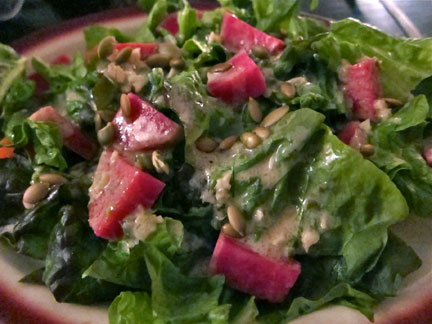
My version leans toward Austria, with pumpkin seed oil in the dressing and toasted pumpkin seeds as a garnish. I also use whole buttermilk in lieu of yogurt, because I'm more likely to have it on hand. (My wife uses it for baking). I'll sometimes leave the fresh dill out if I'm not feeling it. I did so in the above photo. Also, since summer veggies are out of season here in NYC I used a winter vegetable to top the salad - a beautiful mantanghong radish, which is sweet, mild and nutty tasting. They're worth seeking out.

(This recipe serves two)

For the salad:

1 potato, peeled and cubed
1 large beet, peeled and cubed
2 carrots, cut into 1 inch pieces
2 handfuls salad greens
vegetables to top salad (anything in season), cut into bite sized pieces
2 Tbs toasted pumpkin seeds (optional, to garnish)

For the dressing:

generous Tbs olive or toasted pumpkin seed oil
generous tsp white wine or sherry vinegar
1 tsp Dijon mustard
1 tsp capers, chopped
small clove garlic, chopped
1 Tbs fresh dill, chopped (optional)
1/2 tsp sugar
pinch white pepper (or more to taste)
2-3 Tbs plain yogurt or whole buttermilk

Stir dressing ingredients together in a small bowl. Set aside. Boil potato in a small pot. Boil carrot and beet in separate pot. When root vegetables are cooked drain, then fill pots with cold water to stop veggies from cooking further, bringing them to room temperature. After a few minutes drain again. Repeat if they're still hot. Arrange between two plates. Top plated root veggies with a handful of salad greens, then the seasonal veggies you're using. Spoon dressing over each salad, and sprinkle with pumpkin seeds.

Serve as a light meal with bread and butter, or as a starter course to a more elaborate meal.

Friday, November 26, 2010

Grandmom Pries' Turkey Noodle Soup

After Thanksgiving many families use the carcass from the turkey to make soup. There's no rocket science to this. A ten year old with a few minutes of training in knife skills could do it. It's not about technique; it's about feeding everybody still helping to clean the wreckage from the family get together on the day after.

I know my mother (seated just behind the poodle in the photo above) has a pot of this soup on her stove as I type this. But our family recipe has a twist that I have not seen in others: a large can of tomatoes added to the soup, which is then seasoned at the table with Worcestershire sauce. Just how this addition came to be is lost. When I asked my mother her reply was, "That's just the way my mother always made it." Her mother, Marie Pries (née McDaniel) is sadly long gone from us, and no one asked this woman who spent part of her young teen years working in Philadelphia's notorious mills just where the tomatoes in the turkey soup came from. Was it the depression-era ingenuity of a Irish mother of six stretching that carcass as far as she could to feed her family (also friends, neighbors and a spinster Irish immigrant they'd taken in)? Or had she picked up the idea from someone she knew? We'll never know. Are there others in the Philly area who do the same? I don't know anybody outside of my family who makes their turkey noodle soup this way.

But it's brilliant. It's absolutely brilliant. The slight acidic tang from the tomatoes against the earthiness of the turkey, set off by a few salty drops of familiar/exotic Worcestershire sauce? It's the best damned turkey soup I've ever had.

I'm now home from Thanksgiving dinner at my parents' place. Mom dutifully sent me away with a drumstick and part of a wing so I can make my own pot of soup. I will follow my grandmother's recipe, which is no recipe whatsoever - a few of these, a few of those, a pinch of this, a dash of that - exactly how I cook. And I like to think the spirit of the woman who spoiled a much younger me in the way only an indulgent grandmother can will be in my kitchen, savoring the smell of holiday leftovers transformed into a meal as worthy as the holiday meal itself. (I'm guessing she'd approve of my adding a sprig of fresh rosemary - Mom doesn't do it, but I can't resist).

Feel free to try this yourself, and, should you be so moved, raise a glass to the memory of a great woman, my grandmother, Marie Pries. This is her soup. And my mother's. And mine:

You'll need:

Turkey (carcass of holiday bird, or wings, or drumstick - whatever you have)
Onions, chopped (one or two for a small pot, more for a big one)
Celery ribs, chopped (same as above)
Carrots (as many as you want)
Canned tomatoes, broken by hand (big can for a big pot, small can for a small one)
Sprig fresh rosemary
Egg noodles, wide (figure about 1/4lb for every gallon of soup you make)
Salt and pepper, to taste.
Worcestershire sauce, to serve.

Let the amount of turkey determine how much soup you make. Two wings or a drumstick can make about a gallon of soup, which is a small pot. The whole carcass can make about four or five gallons (big pot). Throw all ingredients except noodles into pot. Add water to fill most of the way, cover and simmer for an hour. Use a slotted spoon to fish out all the bones (and what you can of the rosemary). Keep simmering, and add noodles. Stir every minute or two, to keep noodles from sticking until cooked, 6-10min, depending on noodles. Taste, and season with salt and pepper. Don't make it too salty, because you'll be adding a little Worcestershire sauce to the bowl when serving.

If you have some leftover meat, gravy or vegetables they can go into the pot as well. I remember my mother even using dehydrated vegetables from a little jar to beef it up some years. In the absence of a holiday bird I've made this soup with a couple turkey wings from the supermarket, and came out fine. You don't have to roast them, just throw them in the pot. This recipe is as easygoing as my grandmother was. It has been my pleasure to share it with you, Dear Reader.

(Thankfully, you can't see the state typing this has left me in - I'm practically reduced to grade school again, completely broken up over losing her).
Photo by Karen Bowersock Mahoney

Friday, November 19, 2010

Two Fish Stews


Say "fish stew" to most Americans and you're unlikely to get an enthusiastic response. Chowders and gumbos have gone mainstream, usually featuring shellfish. Francophiles drool over bouillabaisse. And that seems to be about where the love of fish stews ends in our culture, unless one is lucky enough to be of Portuguese descent and living on the New England coast. This is a shame. One need not be a fisherman to appreciate a simple fish stew - it's healthy, satisfying, and delicious, not to mention quick and easy to prepare.

My current favorites are based on a simple premise: onions and garlic sauteed in olive oil, to which you add wine and tomatoes, then finish by adding fish for a quick simmer. Here are two variations on this theme:

Italian Cod Stew

(Serves two)

3/4lb cod, cut into bite sized pieces (try to get all the bones out)
1 onion, chopped
3-5 cloves garlic, minced
olive oil
salt, pepper and chili pepper, to taste
glass of white wine
14.5 oz can whole tomatoes, broken up by hand, with liquid
handful of chopped flat-leaf parsley

Heat a heavy bottomed pot, and pour in enough olive oil to cover the bottom. Add onions, pinch of salt, chili and pepper. Saute until onions are nearly translucent. Add garlic and saute a minute or two more. Add tomatoes (with juice) and wine, and simmer gently for ten minutes. Add fish and parsley, and simmer for 2-3 minutes until fish is cooked. Serve with bread and salad (or greens sauteed in olive oil and garlic). The remainder of the bottle of wine goes with it, too, of course.


Basque Tuna Stew

As above, with the following modifications:

- Substitute tuna for cod. Since tuna is richer you might want to use less. Also, no need to blow the cash on the sushi grade stuff here. Traditionally, fishermen made this dish with the tail

- Add a chopped green bell pepper to the onions when you saute them

- Use red wine instead of white (Rioja is perfect). Don't raise an eyebrow about red wine with fish - tuna is practically meat

- Add two potatoes, peeled and cubed, when you add tomatoes and wine. Also add 1 tsp sweet paprika. Cover and simmer gently until potatoes are cooked, 15-20 min. Tuna goes in a few minutes before serving

- Leave out the parsley

(The picture is of the Basque version. You'll notice I added some carrots with the potatoes, for the hell of it. Worked fine). Photo by Cynthia Lamb

Thursday, November 11, 2010

On Fussy Eaters

Just heard a bit on the Brian Lehrer Show about kids (and adults) being picky eaters. I have to admit to a character flaw when it comes to so-called picky eaters: I have absolutely zero patience for them. Eating with them actually makes me angry. I can't help but see them as killjoys.

And yes, it probably goes back to childhood...

Growing up, my sister and I happily ate anything mom put in front of us. Mom knew her way around the kitchen well enough that the family dinner was often one of the day's highlights. She was a picky eater herself, but willing to cook beyond her personal taste to please my more adventurous father. (She still cringes at the memory of the man feeding me pickled herring as I sat in the high chair). She had her limits, though: dad had to keep the Limburger cheese in the garage. The problem was my two younger siblings, who were very fussy as kids (not so as adults, and I love them both dearly). My sister and I would be scarfing down Lima beans, brussel sprouts and the like, while our younger siblings took the very existence of such foods as a personal affront. Mom, whose own dear father was what they called a "meat and potatoes" guy back in the day (what a euphemism!), bent over backwards to accommodate them.

And it drove me nuts.

First off, the person next to you saying, "Yuck!" and pushing their plate away throws a wet blanket over the whole meal. One of the nicer family moments of the day suddenly has to be all about them in a negative way? It didn't seem like a classy move, to me, even as a child. Then there was watching mom scramble to get something in front of them that they actually would eat. We were kids, not angels, and none of us (self included) showed our parents the kind of consideration that in retrospect we've come to know they deserved. Such is life, but having mom cook something else after she'd already prepared a meal seemed a little over the top to me. (Mom didn't seem to mind so much; she understood). From where I sat it looked like taking advantage of her. Finally there was a matter of self-interest. Mom started dumbing her cooking down for my fussy siblings. Dinners at the homes of Italian family friends made this clear. When we moved to Montreal and found ourselves surrounded by flavors from around the world it came into even higher relief. And it made me resentful - not so much toward my siblings, but at what they were doing to my mother's cooking. They were screwing with MY diet!

(Fortunately my then-fussy brother, who is now an arguably better cook than I am, led to the family to discovering Cantonese food right around that time. Even the fussiest of us were - and still are - powerless to resist).

By the time I was out on my own I sought out every bold exotic flavor I could find. Thankfully I have yet to grow out of this, and am married to a woman of equally adventurous tastes.

But I'm left with this character flaw. Whenever someone starts talking about what foods they do and do not eat it's like they're painting a target on themselves. I'm not talking about people with medical, religious or ethical prohibitions. I'm talking about people who have their little lists of Stuff They Don't Like and Refuse to Eat. To each his own, but I don't want to eat with such people. I'm not sure I even want to associate with them. Simply put, they test my otherwise reasonably well-developed tolerance. Understanding this is my issue, not theirs, is no help. I can barely contain the desire to strike out as they drain the joy away from a meal or even a conversation about food.

I've always considered food phobias to be psychological. They are also cultural. Many English and Americans have trouble with cilantro. They complain it tastes like soap, yet people who grew up eating the stuff rarely have a similar complaint. A current theory about this is that the developing brain categorizes items as food and non-food. The taste of cilantro is close enough to that of soap that someone who comes across the stuff after those categories have been established has to deal with their brain recoiling in horror over what it recognizes as eating soap! Research suggests the brain can be re-trained through desensitization, but for many that's more than they're willing to face. Understandable. Childhood is the time to prepare a person for a lifetime of good eating.

Many parents will point out the impossibility of this. Some kids are just fussy, and it's wrong to turn the dinner table into a battleground. I agree... sort of. It's obvious some people are more likely to be picky than others, but I think how those around them react to that determines whether they become someone with preferences or tyrants at the table. How much tyranny is acceptable IS a matter of culture. A friend told me a story that illustrates this point.

My friend is Irish. He grew up a meat and potatoes guy, just like my grandfather. That's perfectly acceptable there - it's practically the norm. (Many Irish consider rice exotic). His wife happens to be French. So when their families got together for a celebration in France, he noticed a vivid contrast between the French and Irish children at the table. The French children happily ate everything put in front of them, including snails, stinky cheeses and all manner of vegetables. The Irish children burst into tears at the sight of the meal, baffling their French in-laws.

He also noticed a difference in the reaction of the parents. The Irish parents had great trepidation over each food presented to their children. Whenever the kids turned their noses up at something they offered them an alternative, often frozen pizza. To be blunt, they expected their kids to be picky, were visibly anxious about it, then rewarded it with pizza. Most kids would trade a plate of veggies for pizza if they had the option. Hell, I would have, and I wasn't even a fussy eater. The French parents, on the other hand, presented foods to their children as "le bon this" and "le bon that." Something good and special the children were getting the chance to try. The parental expectation was clearly that the children would understand they were being given the chance to participate in something wonderful. Turning your nose up at something was unthinkable - this is a celebration, and everything here is something fine and special. The children behaved accordingly.

Perhaps this is simply a manifestation of my own lack of tolerance, but I think there's a lesson there. Kids test limits. A kid with the propensity toward being picky will use the dining table as a chance to test limits, if it occurs to them that's a option. How food is presented to them might just determine their view of opportunities along these lines. Even kids allowed to pass on specific dishes are unlikely to reject a Thanksgiving dinner. Why? Because it's presented to them as something special, wonderful and fine. They don't notice that the turkey is dry or the gravy is lumpy. Or if they do they eat it anyway, because it's special. And it's likely they'll grow up to be sentimental about it, regardless of grandma's cooking ability.

Every meal you have with your family is special. You can see to it that every dish on the table is wonderful and fine, even the simplest things. You can shape a child's perception of a meal. The French do it. So can you. I did it with stepsons eager to find new foods to reject. I couldn't work miracles, but those boys were thrilled to sit down to a plate of cabrito guisado because they knew damned well it was something wonderful, special and fine.

I have nieces who would disagree - they know What They Won't Eat. I've told them I disapprove, and they can keep it to themselves. If they want to be that way at home they're welcome to, but I'm not having any of it. They still excitedly come to visit, and fortunately we can all agree when it comes to Cantonese food. Seems to run in the family.

Sunday, August 22, 2010

Kitchen Gizmos I Actually Use

There are tons of kitchen gizmos out there, and plenty of them are crap. I'm not kidding. Utter crap. Egg crackers (can't crack an egg?), garlic presses, electric can openers (really?), bread machines (automatically make supermarket style bread at home? I don't get it). I've spent much of my cooking life avoiding these things, but at 42 years old I've managed to collect a few gizmos that have proven useful... to me, at least. Living in a NYC apartment where storage and counter space are limited means I have to be ruthless about which ones make the cut. But it's surprising how many I have. It's almost embarrassing to admit how dependent I've become on the following:

Gaggia espresso machine & burr grinder: I finally buckled on this one when I managed to get the machine at a garage sale price. Too good a deal to pass up. I tried using both cheap coffee and a whirling blade grinder, but neither worked with it. The thing was sensitive enough to tell when I was trying to cut corners, and rewarded my efforts with lousy shots. Had to up my game, shelling out the bucks for the burr grinder and good coffee. The result? Espresso as good as a coffee shop at home, for about one-third the cost. Tough to argue with for a household that drinks eight shots a day, minimum. Quite a step up after years of drinking Cafe Bustelo made in an aluminum Bialetti machine. Yes, I've tried the Nespresso rig. It's good - easy and foolproof. But my Gaggia blows its doors off (when fed Counter Culture espresso), in spite of taking up quite a bit of counter real estate along with the burr grinder. Plus the idea of throwing away a plastic capsule after each shot I pull seems wasteful, and I can't stand that.

Pressure cooker: (AKA the WWII microwave). For 20 years I avoided this one, in spite of endorsements from friends and grandmothers who knew what they were talking about. Useless for braising, but fantastic for soups, curries and stews. (Even roasts, though they'll never turn out the same way as they would in the oven). Any long-simmering dish can be made in one-third the time or less in one of these things. It doesn't work miracles, but it allows one to casually make dishes on a weeknight that otherwise would require the kind of time most people only have on a weekend. I'm a convert, using the thing twice a week, sometimes more. Mine is gigantic, as I was advised: You can make a small meal in a big pressure cooker, but you can't make a large meal in a small one. I've cooked for 12 with it, even though most of the time I'm making dinner for two. Today's models have safety valves built into them, so you're not going to replicate those stories you've heard about blowing the lid off and hot food spraying everywhere.

Rice cooker: I'm happy to own the cheapest, meanest example of a rice cooker possible. The kind that was popular in Japan a generation ago, at least. The one that goes for under $25. I love it. Whenever I'm cooking Chinese I can let the rice cook itself while I prep and cook all the dishes. It does a good enough job that I use it for other times I need rice, including Latino and South Asian meals. Only useful if you eat white rice often. I do. Unapologetically.

Electric Griddle/Sandwich press: It's supposed to be an electric grill as well. I wouldn't know; I just use it to make panini and other pressed sandwiches. Pretty much only in the summer, but that's enough to justify the space the thing takes up. If you have a source for good bread and good stuff to put in it this thing allows one to make fancy sandwiches much cheaper (and better, once you figure out what you're doing) than going out for them. Current fave: coppa ham and cheese (Pawlet, from Vermont) on ciabatta bread. Pure indulgence, I know, but affordable indulgence. (My favorite kind).

Immersion blender: I've lived with one of these and without. With is better. It's good for smooth soups and pasta sauces, and if you get one with a powerful enough motor it can also be your food processor and blender. My wife bought one like that, in spite of our inability to find a good reason to give Wolfgang Puck's empire a penny. (His name is on it). Got it from overstock.com. I have no idea how it'll hold up under heavy use, but it takes less space than having an immersion blender, food processor and blender. So far it does all of those functions, in spite of its attachments seeming a little flimsy. Its motor is very powerful. And it was cheaper than replacing the food processor when it died.

Spice grinder: It's an old whirling blade coffee grinder dedicated to spices. Buying whole spices means they last longer. Grinding them as needed only takes a minute, and results in better flavor. Coming up with your own blends is fun. (Amazing how much coriander I go through doing that). I'd recommend this to anyone.

Kitchen radio: Laugh if you like, but my Tivoli Model Two brings me more pleasure in the kitchen than any other gadget. I like good sound in the kitchen. (A sound engineer friend swears by an old KLH, and the Tivoli is just the modern riff on that concept). And it has a small footprint. When radio programming fails me I just plug in a computer or mp3 player and I'm good to go. Can't cook without music. I love this thing.

What about other gizmos? Slow cookers (crock pots) make sense, in spite of most recipes for them sharing a determination to undermine their respectability. They're not for me, but I completely understand where their fans are coming from. If I worked a 9 to 5 job I'd probably have one. What else? I'm not nearly enough of a geek to get a sous vide setup (yet), but I can't argue with its cleverness or usefulness. I loathe microwave ovens, but they are useful for reheating leftovers and thawing frozen blocks of food (and not else, in my opinion). I have yet to throw mine away, although its days are numbered. Also, I'm married to a woman who happens to be a very good baker, and she's fond of her red Kitchen Aid mixer. I've never touched the thing, but it looks good and she gets use out of it. She's even using it to grind grain and roll oats. Currently we're without a toaster (or toaster-oven), which means our oven broiler gets used very inefficiently every now and then. We're not the kind of people who need toasted bread to start the day. If we were, the microwave would already be gone, and there'd be a toaster-oven in its place. If we had more room I'd get a salad spinner, too, because those things are useful. Just can't fit it in. Life in the Big City.

Oh, and we have a kitchen thermometer, because my wife prefers her meat med-rare, over my tendency is to serve it bleu. Now we can debate which temperature constitutes the right level of done-ness, self always advocating a lower number, her having none of it.

Monday, August 16, 2010

Vinho Verde

This is a light, simple wine from Portugal meant to be drunk young. Low in alcohol (usually 10-11%), slightly effervescent, pale in color, light bodied and on the dry side (if less than completely dry) - it's more of a traditional wine than a fine wine, and often priced accordingly. Unfortunately, if you don't happen to live near a Portugese community (such as those in Newark, NJ or Rochester, NY) it can be hard to find. And when you do find it what you come across may clearly show you why it isn't considered a fine wine. Nice examples do exist, and at its best vinho verde is refreshing on its own and pairs well with simple, light summer food. The slight effervescence makes it easy to pair.

This summer I've been drinking Famega Vinho Verde. It's everything likeable about this style of wine, including cheap. It costs me $8 a bottle in NYC. Worth seeking out for the dog days of summer. Serve it good and cold before a meal, with a meal or as an afternoon tipple.

Life may be too short to drink bad wine, but cheap, simple wines have their place. Famega is such a wine, and it's place is at my summer table. I know I'm not the only one who feels this way; my wine shop blows through several cases a week of the stuff.

Gazpacho!


I'll be honest: up until recently I wasn't a fan of the stuff. I think I've figured out the reasons why. Serving size is one. Gazpacho is a bit intense for American super sized portions. It's best served in small bowls. It's really not a meal; it's a starter course, a snack or a side dish. I also have difficulty wrapping my head around the idea of a cold crunchy raw soup. That just doesn't work for me. It's served like a soup, but gazpacho is really a finely chopped salad in a liquid dressing. One that you happen to eat with a spoon. If I think about it this way it makes more sense to me.

And I enjoy it. I like is how it slows me down. I'm generally too quick of an eater. Breaking a meal into several courses works for me because it forces me to slow down a bit and really enjoy myself at the table. Few things slow me down like a bowl of gazpacho on a hot day. A small bowl takes me ten minutes to finish; it refuses to be wolfed down.

It's easy to make bad gazpacho - just use less than perfect veggies and you'll have it. The tomato is most important, but don't neglect the cucumber. Don't use gigantic watery waxed cucumbers, with their horrible giant seeds. Farm fresh kirbys, Persian cucumbers or (in a pinch) those greenhouse English seedless will do. I like red or yellow bell pepper instead of green. If you have a garden use your garden vegetables. If you don't get your ingredients from a farmer's market. Don't even bother making this with supermerket tomatoes or cucumbers. (You can get away with supermarket onion, garlic and bell pepper).

Where can you cheat? Not with chopping the veggies! Don't use a food processor. You want your gazpacho to have little nuggets of crunch, not end up all bruised somewhere along the way a puree. Grab your sharpest knife and chop the veggies into fine little pieces. It only takes a few minutes. A place to cut corners would be using tomato juice as part of the liquid. If your veggies are good a little commercial tomato juice won't undermine the result. The stuff is also pretty heavily salted, so it eliminates the need to add extra salt.

Then there's the matter of serving. It's popular to serve the liquid in individual bowls with each chopped ingredient in it's own bowl. Diners then add how much of each element they want to their own bowl. This is "correct" in that it's frequently served that way in Spain. It's a nice flourish, but I'd rather dispense with it for the improved result when all the flavors have a chance to marry for an hour or so in the fridge.

One more thing: there ought to be no such thing as leftover gazpacho. We're talking tomatoes, cucumber and onion in a salty vinegar based liquid. That will get nasty after a night in the fridge.

This recipe will make two medium sized bowls of gazpacho.

1 perfect ripe tomato, finely diced
1 cup cucumber, finely diced
1/2 small red onion, finely chopped
1/2 red bell pepper, finely chopped
small clove garlic, minced
scant 1/4 tsp ground cumin (too much and it'll taste like salsa)
1/2 cup tomato juice
1/3 cup white vinegar
few drops hot sauce, to taste
drizzle of good olive oil, to finish

Mix together all ingredients in a bowl. Go light on the olive oil so your result isn't too rich. Chill in fridge for 20 min to an hour before serving.
Photo by Cynthia Lamb