Friday, February 25, 2011

Pörkölt

I'm usually so busy eating pork and fish I sometimes overlook the wonder that is beef. I do keep a chuck roast in the freezer most of the time, and recently this has been how it often ends up. While many variations of paprika stew exist, Pörkölt is the most basic, not to mention incredibly tasty. No sour cream, potatoes, tomatoes or sauerkraut involved. Just onions melted in lard, meat, salt, paprika and a little water. (I add garlic and a sprinkling of caraway seeds, which is enough to raise eyebrows among purists). Because of this you want to make sure you use good paprika - the best sweet paprika you can get your hands on. I won't use the nasty lard from the supermarket, either. I get mine from Flying Pigs Farm, so it's outrageously expensive, but delicious, and a little goes a long way. Try to find a good source. This dish is traditionally low simmered until the meat is tender, but it works equally well in a pressure cooker. Serve with boiled or mashed potatoes, dumplings or egg noodles. (I favor garlic mashed, because I have yet to master proper dumplings). Add one of those Germanic salads from a few posts ago and you have a perfect winter meal. Simplicity is good.

This recipe will serve 2-3:

1 1/2 lb beef chuck, cubed
3 onions, chopped
3-4 cloves garlic, chopped
1 tsp lard
salt, to taste
2 heaping tsp sweet paprika
1/4 tsp caraway seeds
1 cup water

Heat lard in pot. Saute onions, garlic and salt over medium heat. Add beef and paprika when onions are nearly translucent and saute for a minute or two. When it starts to stick (don't let it burn) add water and caraway seeds. Cover and bring to a gentle simmer. Simmer until beef is tender, about one hour (or 15-20 min in a pressure cooker). Check several times to make sure liquid doesn't cook off; if needed add a little more water. (You don't need to do this if using pressure cooker, but your gravy will not be as thick as the long simmering method).

Monday, February 7, 2011

"Healthy Food" Rant

I've heard this one too many times: "I want to eat somewhere healthy." Usually spoken by someone looking for a quick bite out. I take it as a sign I will not be dining with that person. Not because I'm against so called healthy eating; changing my own diet allowed me to drop 45 pounds over the last four years. I just reject the notion that one food is healthier than another. Think about it: going to a place that touts healthfulness invariably leads to expensive food short on flavor, often with a dose of dogma to make up for it. It's "healthy" because it's (insert one or more of the following: raw, vegetarian, vegan, gluten-free, low fat, low carb, low salt, macrobiotic, organic or whatever the health trend of the month happens to be).

I understand the desire to grasp at food dogma; one wants to eat healthy, and many of us suspect we do not. But this quickly leads to a forest for the trees scenario. Is the organic vegetarian convenience food item from, say, Trader Joe's obviously a better bet than a bean burrito from Taco Bell? Is the (god forbid) grilled chicken Caesar salad a healthier choice than a burger? Is it really a good idea to punish your taste buds and wallet with the organic quinoa salad and marinated seitan after going through the trouble required to find a place that offers such items? Maybe, but I hardly see any cut and dry answers in this regard. Yet people who make such choices will defend them because they're convinced they are eating healthy by doing so. And I have no reason to suspect they're right in this regard. I refuse to accept that the "healthy choice" is the boneless, skinless chicken breast or the vegetarian option. I don't believe fast or convenience food undergoes a transubstantiation to health food through the power of faith in the grilled chicken breast.

Some absolutes exist. If you cook from scratch at home, not going crazy with the salt, fat and white carbs you're doing better than most dining out options, if healthfulness is your goal. Given. If you eat meat it seems reasonable to be concerned with its provenance, given how much livestock is raised in our industrialized world. And you're probably doing yourself a favor if you manage the complicated trick of avoiding most products of the modern food science lab. At least there's reason to suspect as much. I'll admit to casting a wary eye toward most ready to eat items in supermarkets and convenience stores - things that can sit there for inordinate lengths without going "bad". The longer and less pronounceable the list of ingredients the less likely I am to eat it. But beyond that I don't think there are many absolutes when it comes to specific food items.

I don't think fried chicken, bacon, foie gras or triple creme brie are unhealthy. Nor is a cheeseburger and fries. Or a pizza. Spinach, carrots and hummos are not inherently healthy - eat enough of any and they will poison you. (Eight to ten pounds of spinach is enough to kill you). As convenient as it is for marketing, classifying particular foods as healthy is misguided. It's anti-cuisine, anti-pleasure and unfounded. Fat isn't bad, carbs aren't bad, and I refuse to be convinced that salt and sugar are bad. PATTERNS of eating are healthy or unhealthy, not foods themselves. Recently I've seen the trinity of corn, wheat and soy portrayed as unhealthy, which is nonsense. Pasta, corn tortillas and soy sauce are not out to get you. But a pattern of eating prepared foods made largely from processed corn, wheat and soy? Might not be a good pattern. We know that. If you have any doubts just head to the supermarket and look at the people pushing carts brimming with packaged heat and eat (or ready to eat) items. Do you want to look like that? Then don't eat like that. But even these foods fail to be evil incarnate (although they're probably close). If you like a TV dinner it's not unhealthy to have one. But every night? Welcome to Fatsickville. Potato chips or ice cream? Why not, once in a while? But every day? WTF? It's not the food; it's the pattern of eating. If you eat mostly vegetables rounded out with a little fat, some meat or fish and some carbs you're probably doing fine, regardless of whether or not you eat a pizza or a double cheeseburger once in a while. "Once in a while" being the key phrase.

Your home is where you have control over what you eat. Cook real food. Eat reasonably. It doesn't require lots of time or money, though they do make it easier. Probably best to avoid a pattern of grabbing food on the run. We know that's not a good pattern, even if you choose the so-called healthy options. They're usually not that healthy. And they're expensive. They'll leave you hungry later, more likely to start snacking. And they often taste like crap. Even when they don't it's a gigantic leap of faith to believe a $7 glass of juice with some protein powder or a $10 grilled chicken salad is a healthier lunch than last night's home cooked leftovers. I think of it like this: if I eat defensively most of the time I never have to fool myself into considering "healthy options" when dining out.

Wednesday, January 12, 2011

The Best Thing We've Cooked in a While

It started off with my wife announcing that she was going to make a batch of homemade pasta. I said I'd be happy to make the sauce, and she indicated a preference for a seafood sauce. I figured I'd go in a Sicilian direction, but didn't want to get too close to puttanesca territory. A quick trip to my favorite Chinatown fish market yielded a dozen little neck clams ($4), a pound of cleaned squid ($4) and a pound of shrimp ($5). I had anchovy paste and capers on hand, but knew these would have to be used in a restrained manner. But I had a trick up my sleeve: the shrimp heads and shells boiled in half a glass of white wine gave me a strong shrimp liquor that I added to the sauce. This, along with the juice the clams gave off while being cooked in the sauce added a depth far beyond what the anchovy paste alone ever could have.

The boys got wind of what we were up to and promptly invited themselves to supper, making it a family dinner for four. While it was not a complicated meal, nor an expensive one it did require about an hour of work from two people to make. Then again, we're not the fastest cooks in the world, and it had been over a decade since my wife had made fresh pasta. We could probably bang it out again in 45 min. And we probably will soon. This was much better than what I've had in good mid-tier Italian restaurants here in NYC. And the food cost to feed four was under $15. The worst part of the experience was cleaning the shrimp, but having the shells and heads to beef up the sauce was more than worth it. The extra buck-fifty for the already cleaned squid money well spent, however. This was hardcore enough.

My wife went with a half white, half semolina egg pasta. Rolling it out to the #5 setting on the Kitchen Aid mixer's pasta roller attachment made noodles that cooked to surprising lightness in about two minutes. Hand cutting gave them a pleasant unevenness that highlighted the fact that it was homemade. The noodles were about twice the width of fettuccine making them perfect against the sauce, which came out a bit richer than I'd anticipated (thanks to the shrimp shells).

The payoff for the effort involved was the best meal to come out of our kitchen in a while. And, without bragging, I can say good things come out of our kitchen on a regular basis. This will serve four as a main course or six as part of a larger meal.

For the pasta:

3/4 cup semolina flour
3/4 cup unbleached white flour
2 eggs
2 Tsp water
2 Tsp olive oil

Mix ingredients together and knead for 10 minutes (a mixer with a dough hook makes this easier). Ball it up and place in oiled bowl. Cover and let sit for 20 minutes. On a lightly floured surface cut into four pieces. Feed each piece individually (again, easier if you have the attachment for your mixer) as follows: Roll five times on #1 setting (it may rip, that's OK), once on setting #3 (if it rips here start rolling all over again) and once on setting #5. By now it should be a giant flat lasagna noodle. Gently lay on floured surface and cut into noodles about 1/4" wide. Drape noodles over drying rack or the edge of a very large bowl. Repeat until all four pieces of dough are noodles.

When you're ready to go with a large pot of boiling salted water cook pasta. It will cook in about two minutes, so make sure sauce is ready to go before cooking pasta.

For the sauce:

3-4 Tbs olive oil
5 cloves garlic, chopped
1 Tbs anchovy paste
28 oz can tomatoes (crushed or whole, broken up by hand with liquid)
1 Tbs capers
1/2 tsp crushed red pepper
1 doz clams (I used little necks, smaller is better), scrubbed
3/4lb whole shrimp
3/4lb cleaned squid
1/2 glass white wine
black pepper, to taste

Clean the shrimp, placing shells and heads into a small pan with the wine. Bring to a simmer. Cut the squid into rings and tentacles, and set aside with shrimp meat. In a large pan heat olive oil, garlic and anchovy paste. Fry for about 30 seconds, then add tomatoes, capers and crushed red pepper. Bring to a simmer. When shrimp shells have turned bright pink remove from heat, and carefully pour liquid into the simmering sauce. The liquid ought to be a robust orange-pink. Place the clams into the sauce and cover. When they open they're cooked. Remove cooked clams from sauce, making sure their juice remains in the sauce, and set aside. Discard any that fail to open within ten minutes. At this point the pasta should be ready to go, because you're about five minutes from plating it. Add shrimp and squid to the simmering sauce. When the shrimp turn pink it's done. Cut the heat and add the cooked, drained pasta, stirring to sauce evenly. Plate the pasta, placing the clams attractively on the side of each plate, or if the clams are very small you could toss them with the pasta before plating. Serve immediately.
Photos by Cynthia Lamb

Tuesday, December 21, 2010

2010 Food Trends I'm Sick of

I'm thinking about somewhat expensive meals I've had out in trendy restaurants in 2010. I don't eat like that often, since I cook and tend to favor more traditional foods. But as much as I love grandma cooking I can't bury my head in the sand. There's a big culinary world outside my door, and I won't pretend it doesn't exist. Unfortunately I'm seeing quite a bit bandwagon hopping, brought on by the economic downturn. Something works for one place and it's immediately copied ad nauseum. I'm all for innovation from the very few who can be innovators; I can do without watered-down copycats. But they seem to be everywhere in one form or another. Here are some of their crimes I've noticed this year:

Asian fusion - When it happens organically we get brilliant things, like Vietnamese sandwiches, Japanese curries, Thai food, Korean tacos and Sriracha sauce. In the hands of inspired and talented chefs we get some of the top restaurants in the country, offering exciting flavors and signature dishes. But as a concept in less expert hands it leads to gimmicky, overpriced food. A recent example I suffered through was Asian fusion Southern BBQ soul food. Japanese pizza makes more sense to me, and that's not saying much.

"Gourmet" junk food - A good burger is a good thing, so don't make it a con job. Anyone who sources their meat well and treats it with respect can turn out a good burger. When restaurants start duping the gullible by throwing supposed Kobe beef into a meat grinder and charging high dollars for the destroyed result I'm going to take offense. Same goes for posh places offering "sliders" as appetizers. It's not cute; it's infantile. Don't mess with pizza, either. I have no problem paying over $20 for a pie with a perfect crust and top shelf ingredients lovingly fired in a wood burning oven. But charging that much for a so-so pizza just because someone decided to express themselves by piling it high with silly toppings? That's not only insulting your customers, you're insulting the very concept of pizza. Honest junk food made from good ingredients is a delicious indulgence. Tarting it up and trying to pass it off as fine food is a con job.

Pork belly - I love pork in all of its wonderful forms, belly included. I'm happy it made something of a comeback, and I'll indulge a few times a year. But I don't need to see it on every menu. It's getting a little tiresome.

Ridiculous portion sizes - If I want tapas, meze or dim sum I'll go to places that specialize in such. But if you're going to charge me $12 for three mini-tacos because your concept is "Mexican tapas" I'm going to call you a rip-off artist. Reasonable portions, please. This cuts both ways: if I order an appetizer and a main, and am too stuffed to do more than pick at the main there's a portion control issue, unless it's obvious that dishes were meant to be shared. Unless I'm there for a tasting menu I don't expect to waddle out of a restaurant in pain. And if I have to order four or five items to make a meal I expect there to be at least a vague correlation between the prices and the quality of what arrives at the table. Calling it "tapas" is not an excuse, unless what you serve is actually tapas.

Over salting - I'm not anti-anything, with the exception of low end commercially processed food. Fat is fine. Carbs are fine. Sugar is fine. Salt is fine, too. I expect restaurant food to be saltier than home cooking. When I go out for ramen I know I will consume twice the recommended daily salt intake in half an hour. But I don't expect to be unsure whether the burn in my mouth is from chili peppers or salt, which has happened in more than one popular NYC restaurant. I don't expect to go to a place famous for meticulously sourced ingredients prepared simply, only to find more than one dish nearly inedible because an unsure hand in the kitchen got too enthusiastic with the salt. Salt brings flavor to life, and an extra pinch improves simply prepared food. There is a point of diminishing return, though, and acknowledgment of it would be nice. I know making the food a little extra salty boosts wine sales, and I expect that from a wine bar. I prefer a little more restraint from a restaurant.

Cocktails with food - The fancy cocktail trend is well past its peak. I haven't heard the word "mixologist" in over a year, and I'm thankful for that. So I must voice my disapproval of those who try to prop up this waning fad by suggesting food/cocktail pairings. I'm sure that's great for people who don't like to taste their food, but for the rest of us the idea is laughable.

The "locavore movement" - Now that organic is nearly meaningless people need something to hold onto. So let's take a few things that make sense, such as eating seasonally and favoring locally produced foods, then build some misguided ethos out of it. No thanks. I have no plans to do without my coffee, wine, olive oil, citrus and spices, and have no desire to be part of any "movement". See you at the farmer's market.

Abuse of truffle oil - Oil is the poor man's way to get some truffle flavor into a dish. Yes, it can make your mashed potatoes ethereal, and turn a simple plate of grilled asparagus into a fine starter course. When did it become a commonplace thing, and should we be happy about it? I've only had real truffles a few times in my life, but the oil seems to be everywhere. I don't approve. It's kind of like passing off lumpfish roe as caviar, eating it often, then becoming jaded to the wonder of the real stuff. Or drinking so much prosecco in cans (yes, they sell it in cans) that you lose the ability to appreciate champagne. Hopefully the recent steep decline in truffle oil quality will return truffle flavor to the rare pleasure it once was. As tasty as they may be, a side of truffle fries sitting next to your $25 dollar hamburger is silliness. So is a $10 egg on toast flavored with the stuff. Enough already.

Wildly overpriced Mexican in NYC - I know that good inexpensive Mexican food in this town usually requires a trip to unfashionable neighborhoods. And I appreciate the handful of places that serve truly high end Mexican food. What I can't stand is places that are little more than mediocre taquerias, priced as if they were fine dining establishments because of their location in trendy neighborhoods and the fact that they pour top shelf tequila. I can practically hear the laughter from the left coast, and I'm ashamed for my fellow New Yorkers. This has got to stop.

My fear for 2011 - Sugar. In everything. Sweet sauces everywhere. Meat never served without a sweet wine reduction, a fruity sauce or some kind of sugary Asian fusion rub/dipping sauce. Wine lists will run in the opposite direction, moving toward flinty, mineral wines without a hint of residual sugar, making the sweet food completely unable to pair with anything on the list. And everyone who just graduated from waiting in line for Shake Shack will think it's wonderful.

Sunday, December 19, 2010

Worth a Read: Luard's European Peasant Cookery

My buddy Richard Priest happens to be something of a polymath, in addition to being one of the best tour managers in the business (also business manager, aspiring producer and most recently, a welder). This man endures my endless talk of food with the patience of a saint, setting aside chunks of his precious downtime to join me for walks around Chinatown, where we seek out holes in the wall serving delicious meals for pocket change. His fluency in Mandarin gives him a better picture than I'll ever have of the goings on around us. (I have only a handful of sentences in Cantonese). Every now and then he honors me by being a guest at my table.

One such night Richard gifted my wife and me a copy of Elisabeth Luard's excellent book: European Peasant Cookery. This book is not breaking news. It was published in 1986. The recipes are for foods that are hundreds to thousands of years old, covering cuisine from Norway to Turkey. It's more than a collection of recipes - it is a great read. Luard can write, and chooses to preface most recipes with engaging descriptions of the land and the people, putting the recipes in cultural context. No surprise this woman has had over ten books published! This one is both inspiring for the cook and, I would guess, a pleasure for anyone interested in reading about food.

European Peasant Cookery provides the reader with a vibrant mental map of traditional cuisines across Europe. For me this not only brings back memories of meals I've had while traveling, but it adds new must tries to the list for future travels. Traditional food pairings are sketched out as well, which is great for those who appreciate thematic continuity at the table.

Then there are the recipes themselves: all bulletproof. Luard puts them in context, mentioning a few variations and common substitutions. By the time I set out to cook I don't even need to refer back to them; they seem as obvious as if I'd learned them from my grandmother. Sure, some of them are beyond the scope of what I plan on doing in my NYC apartment. As of yet I have no plan to cure my own ham or bacon, for example. Nor will I be making my own skyr (Icelandic farmer's cheese), though I wouldn't put that past my wife, who already makes her own buttermilk. Let's face it, cooking at home is much more enjoyable when you're inspired. And the recipes in this book cover so much ground it's easy to open to a random page and find inspiration. Lots of "I can do that" moments here, which lead to, in my case, casually deciding to make a Spanish (or Norwegian, or Greek, or German) meal. Luard even gives the reader a handle on the seasonality of the dishes.

Some future posts to this blog are bound to come from playing around with the recipes in European Peasant Cookery. It already inspired the fish stew post. (Lately I've been obsessed with fish - the first 90 pages of this book are on seafood, and they're becoming increasingly well-thumbed).

Monday, November 29, 2010

Germanic Salad in Buttermilk Dressing

I've traveled in the German-speaking world many times, often enjoying the food there more than I expected to. I expected the great brown breads, the good beer, wursts and schnitzel. But I loved being caught off guard by things like a sublime venison stew in Switzerland, outrageously good pork in Germany and the best pumpkin soup of my life in Austria. (Great wine in Austria as well). Of all the great things I've eaten in the German-speaking world, one that ended up in my own kitchen was one of the simplest: a composed salad with a dairy-based dressing (joghurt salatsauce). Variations of this salad can be found throughout Scandinavia as well. Easy to understand its popularity.

I first had this salad on tour with folksinger Rod Macdonald somewhere in Germany. Our bass player was a vegetarian, so large salads showed up at our table along with the meat dishes Rod and I ordered. They were often layered: cooked root veggies on the bottom (beets, potatoes), salad greens, then more veggies on top (cucumbers, tomatoes, radishes, sprouts, corn, celery - whatever was good and in season). The dressing was a vinaigrette, beefed up with a pinch of sugar, some yogurt, chopped capers and fresh herbs (usually dill). That's pretty easy, adaptable and substantial. In my kitchen it's the perfect accompaniment to the classic northern meal of buttered brown bread topped with cheese, cold cuts or smoked/pickled fish, with maybe a side of pickles. I'm married to a woman who makes that bread, and the weather in NYC is right for that kind of eating now. So I've been making this salad pretty often.

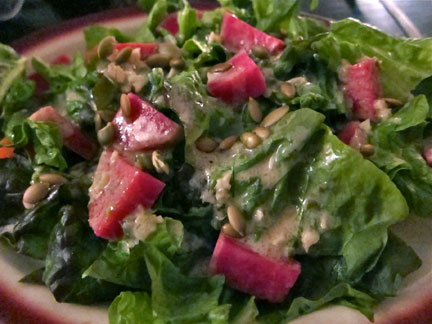
My version leans toward Austria, with pumpkin seed oil in the dressing and toasted pumpkin seeds as a garnish. I also use whole buttermilk in lieu of yogurt, because I'm more likely to have it on hand. (My wife uses it for baking). I'll sometimes leave the fresh dill out if I'm not feeling it. I did so in the above photo. Also, since summer veggies are out of season here in NYC I used a winter vegetable to top the salad - a beautiful mantanghong radish, which is sweet, mild and nutty tasting. They're worth seeking out.

(This recipe serves two)

For the salad:

1 potato, peeled and cubed
1 large beet, peeled and cubed
2 carrots, cut into 1 inch pieces
2 handfuls salad greens
vegetables to top salad (anything in season), cut into bite sized pieces
2 Tbs toasted pumpkin seeds (optional, to garnish)

For the dressing:

generous Tbs olive or toasted pumpkin seed oil
generous tsp white wine or sherry vinegar
1 tsp Dijon mustard
1 tsp capers, chopped
small clove garlic, chopped
1 Tbs fresh dill, chopped (optional)
1/2 tsp sugar
pinch white pepper (or more to taste)
2-3 Tbs plain yogurt or whole buttermilk

Stir dressing ingredients together in a small bowl. Set aside. Boil potato in a small pot. Boil carrot and beet in separate pot. When root vegetables are cooked drain, then fill pots with cold water to stop veggies from cooking further, bringing them to room temperature. After a few minutes drain again. Repeat if they're still hot. Arrange between two plates. Top plated root veggies with a handful of salad greens, then the seasonal veggies you're using. Spoon dressing over each salad, and sprinkle with pumpkin seeds.

Serve as a light meal with bread and butter, or as a starter course to a more elaborate meal.

Friday, November 26, 2010

Grandmom Pries' Turkey Noodle Soup

After Thanksgiving many families use the carcass from the turkey to make soup. There's no rocket science to this. A ten year old with a few minutes of training in knife skills could do it. It's not about technique; it's about feeding everybody still helping to clean the wreckage from the family get together on the day after.

I know my mother (seated just behind the poodle in the photo above) has a pot of this soup on her stove as I type this. But our family recipe has a twist that I have not seen in others: a large can of tomatoes added to the soup, which is then seasoned at the table with Worcestershire sauce. Just how this addition came to be is lost. When I asked my mother her reply was, "That's just the way my mother always made it." Her mother, Marie Pries (née McDaniel) is sadly long gone from us, and no one asked this woman who spent part of her young teen years working in Philadelphia's notorious mills just where the tomatoes in the turkey soup came from. Was it the depression-era ingenuity of a Irish mother of six stretching that carcass as far as she could to feed her family (also friends, neighbors and a spinster Irish immigrant they'd taken in)? Or had she picked up the idea from someone she knew? We'll never know. Are there others in the Philly area who do the same? I don't know anybody outside of my family who makes their turkey noodle soup this way.

But it's brilliant. It's absolutely brilliant. The slight acidic tang from the tomatoes against the earthiness of the turkey, set off by a few salty drops of familiar/exotic Worcestershire sauce? It's the best damned turkey soup I've ever had.

I'm now home from Thanksgiving dinner at my parents' place. Mom dutifully sent me away with a drumstick and part of a wing so I can make my own pot of soup. I will follow my grandmother's recipe, which is no recipe whatsoever - a few of these, a few of those, a pinch of this, a dash of that - exactly how I cook. And I like to think the spirit of the woman who spoiled a much younger me in the way only an indulgent grandmother can will be in my kitchen, savoring the smell of holiday leftovers transformed into a meal as worthy as the holiday meal itself. (I'm guessing she'd approve of my adding a sprig of fresh rosemary - Mom doesn't do it, but I can't resist).

Feel free to try this yourself, and, should you be so moved, raise a glass to the memory of a great woman, my grandmother, Marie Pries. This is her soup. And my mother's. And mine:

You'll need:

Turkey (carcass of holiday bird, or wings, or drumstick - whatever you have)
Onions, chopped (one or two for a small pot, more for a big one)
Celery ribs, chopped (same as above)
Carrots (as many as you want)
Canned tomatoes, broken by hand (big can for a big pot, small can for a small one)
Sprig fresh rosemary
Egg noodles, wide (figure about 1/4lb for every gallon of soup you make)
Salt and pepper, to taste.
Worcestershire sauce, to serve.

Let the amount of turkey determine how much soup you make. Two wings or a drumstick can make about a gallon of soup, which is a small pot. The whole carcass can make about four or five gallons (big pot). Throw all ingredients except noodles into pot. Add water to fill most of the way, cover and simmer for an hour. Use a slotted spoon to fish out all the bones (and what you can of the rosemary). Keep simmering, and add noodles. Stir every minute or two, to keep noodles from sticking until cooked, 6-10min, depending on noodles. Taste, and season with salt and pepper. Don't make it too salty, because you'll be adding a little Worcestershire sauce to the bowl when serving.

If you have some leftover meat, gravy or vegetables they can go into the pot as well. I remember my mother even using dehydrated vegetables from a little jar to beef it up some years. In the absence of a holiday bird I've made this soup with a couple turkey wings from the supermarket, and came out fine. You don't have to roast them, just throw them in the pot. This recipe is as easygoing as my grandmother was. It has been my pleasure to share it with you, Dear Reader.

(Thankfully, you can't see the state typing this has left me in - I'm practically reduced to grade school again, completely broken up over losing her).
Photo by Karen Bowersock Mahoney